Sunday, February 8, 2026

A New American Genre

The American Sagas Genre 

What Is Genre and Why Do We Need It?

     As an author, I have a very great understanding of what genre is -- but does everyone? If you google what a genre is, you will get the Oxford definition

"a category of artistic composition, as in music or literature, characterized by similarities in form, style, or subject matter." 

This is a very well-put definition, but for literature, I define it a little further

"it's the literary category of which a piece of literature most closely meets the requirements set by the community of already-existing literature that is commonly known to define the genre."

That may seem a little wordy and confusing for some, so let me use this example to clarify and define sub-genre (a sub-genre is a body of literary works that share characteristics with the overarching genre and with other works that have additional characteristics in common): the Romance genre of literature requires the following: the main focus must be on one or more romantic relationships and there must be a happy ending for at least the main romantic relationship of focus; examples of sub-genres in the Romance genre include the following: 

  • Romantasy (a blend of Romance and Fantasy genres), 
  • Historical Romance (novels having both Romance and Historical Fiction genre characteristics), 
  • Erotica (Romance Fiction that focuses on the detailed, sexual encounters between characters, and without these sexual experiences, the whole story is non-existent or completely falls apart; this sub-genre, like others, requires and expects specific jargon), and 
  • (Modern) Dark Romance (Romantic Fiction that focuses highly on the darker parts of relationships, like obsession, the horrors involved with deep love, fear of others especially in relationships, and generally, just the most horrible, twisted, down-trodding, adult parts of relationships -- at least, from my understanding of it, the issues in the relationships are more serious, adult, and horrible than in the traditional Romance genre). 

     Before the 1970s, genre wasn't such a big deal -- even knowing the line between fiction and non-fiction (the original genres, in addition to a third: poetry) was fuzzy. In fact, most of our literature from the past is defined by the accepted characteristics of literature from the time period in which it was written. For example, we remember early-19th-century American literature mostly by the overly descriptive pages of nature, the wilderness-man hero who is rejected by civilization but who proves to be the most valuable resource for surviving, and the typical, pure, civilized lady who needs a strong, resourceful man as a partner -- and we call it Romantic (in a different sense from what we know Romance as today); but, this body of literature, in this 19th-century-American-Romance genre, was the published literature of the time because it was what readers wanted and expected. Following, we all have heard of Moby-Dick, Herman Melville's great American Classic masterpiece, which is the best example of how not meeting reading-community expectations can turn readers against an author for life -- because Melville wrote in the 19th-century-American-Romance genre up until Moby-Dick, readers expected the same from him, but what they got in Moby-Dick was 19th-century-American-Dark-Romance instead, and it ruined his writing career (even though he wrote ALL of his true masterpieces after this!). If genre would have been emphasized in Melville's time, perhaps his life wouldn't have taken the turn that it did because of Moby-Dick and its VERY negative reception during his lifetime! 

     We went so long without too much focus on the differing characteristics of literature (and defined genres) because it was inherent that if it was being published, it had merit as what readers wanted and expected. Since publishing has become so widespread, inclusive, and common (since after 1950), we now need separations of genre because we need to know where the merit lies. Merit has become individually subjective: some like to read only Historical Romance, some like to read only Fantasy novels, yet others will ready Stephen King's works no matter what he writes. Too, even if a book isn't well written and hasn't been edited properly, it may still have its niche in its given genre or sub-genre if it meets those expected characteristics for the genre well. If a book doesn't fit into any one genre, however, does it have merit at all, even if well written? To the reading and writing communities, perhaps not -- and we all think this way, whether you realize it or not. We know what we like, and we like our comfort zones; this extends to our tastes in literature: if we've found we really like the Harry Potter series, we may get stuck reading children's literature (and perhaps Young Adult literature) for the rest of our lives! I've known MANY readers like this! -- I encourage you to never get stuck in just one genre as a reader, because there is SOOOO much out there that is fantastic, and it's all in different genres!

Cross-Genre Literature

     In recent decades, we have seen a rise in further divisions of genre. Why? Because we adapt and change, and the changing times and atmospheres we live in determine more what we want than we realize. Melville is still a great example here, too: all his work after 1850 was rejected because of Moby-Dick's reception, and for the remainder of his life his writing was ignored no matter how good it was; however, after World War I, Americans felt differently about his later works (after this war and the atmosphere that resulted from this war) and the "Melville Revival" found ground in how his most famous literature spoke to Americans; it's the "Melville Revival" we have to thank for believing that Moby-Dick is the Great American Classic today. 

     We've slowly been moving toward wanting books that are increasingly different. We got tired of focusing on any type of hero, for example -- we are interested in the psychology of the villain. Why is the villain so terrible? That's intriguing to us now, where decades ago, the villain was just the "bad" guy and we wanted to see the "good" hero save the day no matter what happened to the "bad' guy; the "bad" guy deserved whatever he got for killing all those innocent people. Now, after the Vietnam War and the widespread growth and availability of mental-health care, we want to help the villain so that he can rejoin society, share his stories with us, and become someone we want to have dinner with again (not that many of us actually sit down with the TV off for dinner anymore...). And, where do his stories fall when it comes to genre, because we want only the audience who will enjoy his stories to read them? Well, they may fall in non-fiction -- like memoir -- or they may fall in fiction -- because he changes some things in his real stories -- or, maybe he creates a new genre that combines fiction and non-fiction, short story and novel, war story and memoir, as Tim O'Brien did. Why stick to one genre when real life doesn't? Why change the story to meet a single genre's characteristics? Isn't that unfaithful to the story that should be told? 

     Cross-genre literature (it's own genre now which simply requires that a work meet the characteristics of more than one genre, as Romantasy does) has been rising just as long as the numbers of genres has been exponentially growing. Why has Cross-Genre literature grown into its own genre? ...because genuine, unique works of today don't fit into traditional genres. ... because readers often grow tired of reading the same stuff over and over. ...because, eventually, we want something new and fresh without leaving our comfort zones too much. But, there is a very unique problem with this "genre": it doesn't tell us where the merit lies. What genres are being combined in any Cross-Genre work? Perhaps that is defined on any published Cross-Genre book's back cover or dust jacket, but perhaps it is not. The characteristic(s) of this genre buck the goad of what genre requires. 

     But, again, why has this very vague "genre" grown? ... because there are too many genres to choose from. Take a look at this not-all-inclusive Wikipedia list of literary genres and sub-genres. One source in a Google search says there are 144 genres and sub-genres... but I doubt that one is an all-inclusive list, either. So, is it time we start telling readers what to expect from our books in a different way (other than by claiming it is belonging to a specific genre)? This is definitely something to think about changing, in my educated opinion. But, for now, I suppose I will define my own genre... that does seem to be the expectation if my work doesn't fit into any of these many, many genres and sub-genres that exist today, as plentiful as they are. 

The American Sagas Genre

     My Merely Mortal Series is very complex and covers multiple millennia. The first book of the series is very unique: it blends Psychological Thriller with mystery, supernatural, metaphysical, romance, coming-of-age, survival... it is written like a puzzle, with a pieces guide and a color guide in addition to its table of contents... and it is even more unique in that it embodies my writing journey as an author from childhood to early adulthood. The second book of the series follows the main characteristics of the modern Romance genre but blends with it occult, supernatural, survival, horror, psychological, erotica (without the jargon used in the Erotica genre), historical, coming-of-age, metaphysical, fantasy, modern dark romance, and philosophy; it is very unique in that I created the Tebawa people, culture, and language, that I felt the need to include a "Quick-flip Dictionary" for translating the Tebawa words sparsed into the text immediately before Part III, and in how I'm tying it back to the first-published novel of the series (there are missing pieces from the puzzle of the first-published book found at the end of each novel in the series). The third novel is mostly Supernatural Horror, but again, it blends that with romance, erotica (without the jargon of the Erotica genre), modern dark romance, fantasy, metaphysical, thriller, mystery, political, historical, coming-of-age, philosophy, religion, mythology, et cetera; it is highly unique in its immersive-ness through the sparsing of Tebawa language with English (there are multiple Tebawa language guides in this one), in its collaboration with a reader/writer who submitted about 1/5 of the final manuscript as a short story (in response to the Demiar or Tedemiar? quiz; this short-story was edited considerably before working it into the manuscript), and again, in how it ties back to the first novel of the series (through the missing pieces included at the end). The first short story of this series is a short story -- short stories are their own genre and I don't care here to place it into a sub-genre other than (fictional) Sagas. 

     So, really, where does my Merely Mortal Series series fall in terms of genre? We could call it Cross-Genre, but that does NOT accurately represent it at all; it is much more unique than typical Cross-Genre works, and it blends a whole lot more than two genres (each of the three books so far all follow a different genre's characteristics most closely!). This series has a very specific audience who will like it: 

  • you must like complex, in-depth narratives told from multiple points of view and perspectives; 
  • you must be able to handle extreme intensity that may traumatize you, taboo and occult characters and events, and have some true grit; 
  • you must be willing to be pulled into the story by your lapels through the sparsed language (which becomes more and more prevalent in the text as it moves forward); and 
  • you must be intelligent enough to handle the unfamiliar Tebawa vocabulary and the higher English vocabulary throughout. 

     I mentioned above that I place the first short story of this series into the Sagas genre/sub-genre. Let me define this genre here; Sagas... 

  • incorporate supernatural elements [1]; 
  • are very long narratives [1]; 
  • span multiple generations of characters [1]; 
  • have very expansive scopes, sometimes covering whole civilizations or cultures [1];
  • use various literary devices, necessarily including varying names for characters [1], including archetype [2]; 
  • blend historical fact and mythology [1, 2], "creating a rich tapestry of reality and fantasy" [1]; 
  • often incorporate extensive monologues to reveal character motivations and complex themes [1]; 
  • central themes include exploration of fate versus free will; moral dilemmas that test "loyalty, courage, and integrity"; the interplay of mere humans with gods and supernatural beings; cultural identity and origins; revenge, blood feuds, and cycles of violence; and hospitality, social bonds, and friendships [1, 2]; also, exploring "love, adventure, and conflict" [2];
  • employ non-linear storylines, using flashbacks, prophecies, parallel stories, and interwoven plots [1]; 
  • episodic storytelling -- "loosely connected adventures or incidents contributing to overall story arc" [1]; 
  • sometimes include frame narratives where a character tells the story of the past from present-day, "adding layers of perspective and interpretation" [1]; 
  • focuses on different characters and their interconnected stories [1]; 
  • "make extensive use of foreshadowing and dramatic irony" [1]; and
  • combine numerous genres within one large work [2]
Modern examples of what can be considered Sagas include J.K. Rowling's Harry Potter series and J.R.R. Tolkein's Lord of the Rings and Hobbit works; the most famous American work that I can think of that is a Saga is George R. R. Martin's Game of Thrones series, which I have previously been using to classify my series as predominately "Adult Fantasy," but it is yet another genre that I feel doesn't precisely reflects its contents. So, here, I define the American Sagas genre; it:

  • incorporates supernatural, metaphysical, and/or occult elements; 
  • uses very long narratives, spanning 3 or more separate works;
  • spans multiple generations of characters and peoples; 
  • has very long, complex storylines and a humongous overarching plot;
  • uses various literary devices, necessarily including varying names for characters, archetype, foreshadowing, and dramatic irony; 
  • blends history, fantasy, psychology, horror, romance, and more -- like real life does; 
  • uses monologue to reveal character motivations and complex themes; 
  • uses non-linear stories, with flashbacks, parallel stories, and interwoven plots; 
  • uses multiple points of view and perspectives to develop detailed characters and plot lines that contribute to a large, overarching plot; 
  • has parts that can stand on their own but that at least loosely relate to and contribute to the overarching plot of the whole saga; 
  • has very complex characters, very complex plot lines, and very detailed descriptions of events and characters; and
  • has at least one thing throughout the saga that makes the saga VERY UNIQUE and inherently American.

     For others, I realize that these genre strictures may not be easy to meet. Honestly, is it what I intended with my stories in the Merely Mortal series -- in a way, yes; in other ways, no. I have always seen the overarching plot and the interrelations of characters and events, but it was only in recent years that it began spanning multiple millennia. My series started as a puzzle with interwoven storylines, loosely connected pieces, and missing pieces; now, the beginning of the chaos has begun in the Tebawa forest in the eastern U.S. thousands of years ago. If you're interested in my Merely Mortal series, expect to be pulled into a saga that meets the above characteristics for the American Sagas genre. 


[1] Fiveable Content Team. "Epic and Saga Unit 1 Review: 1.1 Characteristics and Definitions of Epics and Sagas." Fiveable, Fiveable, Inc., 2026, fiveable.me/epic-and-saga/unit-1/characteristics-definitions-epics-sagas/study-guide/T14Domr7T0j0KLrx. 
[2] Sheposh, Richard. "Saga." EBSCO Knowledge Advantage, EBSCO Information Services, Inc., 2024, https://www.ebsco.com/research-starters/literature-and-writing/saga. 

Friday, July 25, 2025

A God-Appointed Chosen One & Exclusive Author Interview!

A God-Appointed Chosen One 
& Exclusive Author Interview!

(Image received directly from the author)
Chains of Prophecy
Book 1 of the Samuel Buckland Chronicles 

by Jason P. Crawford

My rating on a 100-point scale: 97

How I discovered this book:
When signing up for the author's newsletter (introduced via Twitter/X), I received a free copy of this book!

My synopsis: 
   Samuel Buckland is an accountant who, one day, takes one thing a little too far and loses his job over it. Then, more tragedy strikes him. Could the two most negative events in his life be connected? It seems they may be... but Sam has some trouble coming to terms with what he seems to be destined for. Events force him to try and be a savior in a way he could have never imagined, and he seems to be a natural at it, but he's never been taught how to do what he can, and the ancient book that would help him succeed in his endeavors comes up missing... What follows is a kind of war, a journey of discovery, and the reader is swept along with Sam as he stumbles his way through seemingly insurmountable challenges. 

My review: 
   I was VERY pleasantly surprised with this independently published GEM of a novel! The plot and words are intricately woven to keep a reader intrigued, entertained, and looking forward to what happens next. The characters are complex and struggle with themselves and each other. The story is clear, has details that ground the reader well, and there are some nice twists here and there. For an example on the writing style, see this short excerpt from Chapter 1: 

Gregory had been clear on how this was his space, how he needed a room to do his work and have things his way. At first, his wife had worried that there was something... untoward going on, that maybe this room was where he would stash his child pornography or something like that. As years had passed, however, she had come to accept the fact that, sometimes, a man needs a place to be himself. 

Here, we see easy character development, and the slow creation of a mystery: Gregory is even hiding something from his wife at home -- he somehow comes up with brilliant ideas in this space related to his success... but that's nothing sketchy -- is it?

    Some themes I picked up from this novel concern overcoming adversity despite the shortcomings you encounter within yourself, the importance of appreciating what you have, and rising to challenges with confidence to succeed -- all messages worth receiving. Another theme, God has a plan for you, and other religious themes, can be seen in text like this, from Chapter 3: 

     Although only five years old at the time, Sam had still been possessed of a prodigious intelligence. He had thought about his great-grandma's question for several moments before answering. "I think it's because Solomon was using God's magic, but the witches were using bad magic." 

        More laughter from the old lady. "Exactly what I thought you'd say." She had clapped her hands together before leaning in closer. "Don't forget this, Sammy; there is good and evil in the world, but all of that is in here," and she pointed as his head, "and in here," to his heart. "A rock can kill people, or a rock can build a house, but a rock can't be good or evil. Magic could hurt people, or it could help them; it was the magician, the sorcerer, who decided if they were working for God or not..."  

Here, I know there are readers out there who may think "blasphemy!" at using magic at all, especially when saying God condones it, whether for God's purpose or not. That's okay (that's why I'm mentioning it here, so you know) -- but there is magic in this book, both magic being used for good and magic being used against the betterment of all. In my educated opinion, it enhances the story and its entertainment value -- and it's fiction -- we are not saying this is real!
     With the right amount of "figuring it out," readers follow Sam as the story builds up to an exciting climax, an unpredictable reveal, and a very fulfilling resolution. There is an excerpt from the beginning of the next book at the end, and I totally drank that up. Sam is such a well-developed, dynamic, realistic character (despite the magical elements) that you'll want to visit with him and follow his adventures more -- it may be a little addicting, I'll warn you. 
     The reading flows easily after the initial "what the...?" of the opening pages. There's a sense of mystery about what the "villain" of the story is exactly doing -- why does he have a secret warehouse and what is he doing there? Whatever it is, it seems to be tied to his prominent influence as a politician. Sam, just a former accountant, must approach this insurmountable power again and again to answer questions and overcome the evil of the story, creating a kind of intrigue that keeps a person intrigued and reading on. 
     There's just one thing that is a little irksome to me, personally, but it's a little, vestigial thing from long times past, and not a big deal at all: the author puts "The End" at the end of the book, and at the end of the preview to the next book. Just a little thing, but when it's a series, it's not the end, you know...
   
My Goodreads updates: 
I had 3 updates on Goodreads while reading this book: 
"So far, a captivating author intro. and a captivating read!"
"I think I’m enjoying this more than any other indie book I’ve read so far (except my own, that is…)!
"The author is handling mental instability well ☺️."

I highly recommend to... 
Fans of fantasy and paranormal novels and thrilling reads with religious themes.

Suggested restrictions: 
I do not suggest this novel for anyone less than 13 years of age due to sparse adult language, some adult situations that may not be suitable for younger readers, and mild, magical violence.

I'm going to brag for the author a little bit here: 
Chains of Prophecy won the 2014 Paranormal Silver Global Ebook Award
This novel currently has 4.25 on Goodreads (which better than most classics)! 
Also, this whole series (all 5 books) consistently has above 4 stars on Amazon!
-- So, I'm not the only one who says it's GREAT!

Links and information from Amazon are at the end of this post! 

When finishing up this book, I thought, oh my goodness, an indie gem like this, I want to resurrect my book blog to talk about it! I reached out to the author, and he agreed to an exclusive interview here! 


My interview with the author, Jason Crawford: 
Tell us a little about yourself. What do you like to do when you’re not writing? Are there any people who are extra special to you as a writer or as a person that you would like to tell us a little bit about as well?
I was born in Bogalusa, Louisiana, to Army parents. We moved around a lot—Germany, Panama, Maryland—until we came back to Louisiana, where I lived until I myself joined the military as a cryptologic linguist. That's where I met my wife of now 21 years, Cherrie, or CL Fors as she's known for her award-winning art and amazing science fiction. I have four children from 18 to 9 years old, love tabletop roleplaying, and teach high school Physics in southern California.
That sounds interesting and eventful! We have something in common -- I love studying language; I call myself a "linguistics nut" at times. It's so great that you have multiple successful writing careers in your family. 😁

(This picture taken from Mr. Crawford's website)
I know there are tons of ups and downs with being an author. What is the best part of writing for you? What is hardest about it?
 
The act of creating the story is my soul's ambrosia. I write what I want to read and I love every moment of it. The hardest part is, of course, rejection—whether that's my first reader telling me that I didn't manage something the way I wanted, or the repeated form "No thank you's" that I get from short-story magazines; it's never fun. Still, I've gotten to the point where I can absorb most of those without falling down or getting depressed. Usually.
I completely understand! I love that I can say that I loved your book enough to give you further praise! 

I just saw a Twitter post yesterday about the "coincidences" of our characters and events in relation to real-life people and events that we generally put at the beginning of fiction books as a disclaimer. Are the characters in your books based on people in real life? If they are, would you care to share with us who? If they aren’t, how do you create complex characters for your books?
I definitely take traits from people that I know, but I don't ever make the character the same as they are. The character starts as a general idea; for instance, Sam Buckland, from Chains of Prophecy, started as "A genius accountant has to save the Archangel Gabriel from being captured by a politician/businessman." That, and the idea of the Keys of Solomon, was all I knew about him when I started. My characters are complex because I let them make decisions, steer the story, and tell me what they're going to do. I don't control them (except in very rare instances); they control the writing by the choices they make.
Mine, too! My characters often change my plans for a story after I've planned it out. They're like, nuh uh, that's not how that happened... This is how it happened. 

What would you say to a reader who approached you and praised your work, saying Chains of Prophecy is one of their absolute favorites?
 
This has happened! I was vending at a local convention and a reader came up, saying she'd bought my book at the last event I was at and showed me how beat-up it was because she'd been reading it so much. I gave her a new signed copy, and we've been friends since. This is the best feeling that a writer can have, and I encourage all readers to let their favorites know that you love their work. It makes our day, every time.
That's wonderful! Thank you for sharing that -- perhaps it will be inspiration to both readers and writers who are readers to do just that! 

Now that you've clearly had success with your writing endeavors, I want you to reflect on what inspired you to become a writer. What would you say to someone who asked you why you do what you do? How has writing affected your life?

Becoming a writer has happened in three stages. In 2012, my sister-in-law suggested to my wife and I that we try writing, since we're creative and intelligent. That's how I wrote my first book, The DrifterChains followed soon thereafter.

The second stage happened much more recently. In 2024, my wife returned from her first Superstars Writing Seminar in Colorado, an annual event made by several influential authors like Brandon Sanderson and Kevin J. Anderson. She was effusive about how wonderful it was, and her experience inspired me to really try with my writing. I started setting aside more time, submitting to short-story markets, and putting myself out there. I made my first fiction sales to anthologies here.

The third stage, the present, happened after attended SSWS in 2025. I realized that writing fuels my soul, that it isn't work, and that it's what I want to spend my life doing. I want this to be my full-time career,  crafting stories for myself and others. Since February of this year, I've written three full novels and I have plans for more. I can't stop, don't want to, and I'm so grateful for this chance.

That is absolutely wonderful -- your evolution to the writer you are today! Thank you for sharing your writing journey with us. 😃

I've very much enjoyed this opportunity to get to know you a little better and wish you further success with your writing career. Have a great weekend! 


Find this awesome author online: 
Website: https://www.jasonpatrickcrawford.com/ -- here, learn more about his work and awards!
Also, you can sign up for his newsletter on his website! (It does NOT spam your inbox AT ALL!) 
Connect with Jason on his website, on Facebook, on Twitter, and on GoodReads!
Currently, for signing up for his newsletter via Bookfunnel, you receive "Legacy of Lies" for free!


Amazon Author Bio: 
(Taken from Amazon)


(Alternate cover from Goodreads)
Synopsis from Amazon
   Samuel Buckland has everything going for him—until a single encounter shatters his certainty and thrusts him into a hidden war of magic, myth, and ancient prophecy. Gregory Caitlin, a rising star in politics and business, claims he’ll bring hope to a crumbling world—but his ambitions hide something far darker. When their paths collide, even angels falter.

Sam must grapple with forces he never believed in—demons, djinn, and an ancient power long thought lost. Gregory walks a razor’s edge between messiah and tyrant, and he’s not above using forbidden knowledge to shape the future.

Their choices will tip the balance between salvation and ruin.

Chains of Prophecy (Book One of the Samuel Buckland Chronicles) is a fast-paced blend of modern fantasy and ancient lore, perfect for readers who enjoy smart, character-driven stories with deep mythological roots and explosive consequences.  


Tuesday, May 24, 2016

One for Mental Health Awareness Month

It's Not Your Journey by Rebecca Lombardo 

Image taken from www.goodreads.com.
My rating on a 100-point scale: 85 

My recommender: This one was a Twitter discovery for me. I offered to review this book honestly in exchange for a free copy. 

My review: 
     I maybe shouldn't start out my review with this and the author and I discussed possible issues of relating too well beforehand, but I found that I related a little too well to this author's autobiography. I must say I was a little hesitant to read for fear of what may come of it, and the author did express concern and encourage me to be sure that I "be in a good place" before embarking upon her journey, but I'm glad I chose to travel it with her. The author very much captures the thought processes involved in having mental health issues and I found myself easily drawn in. This is both good and bad: first, it means the author has very well captured what it's like to have mental illness and those who don't suffer from one may be able to understand what it's like through her work, but it also means I had an intense reaction to reading this work (I got a bit depressed, and suffered some physical symptoms, such as muscle spasms, pain, chills, etc - with my anxiety disorder, my psychological issues manifest into physical issues). For this reason, I recommend those with mental health issues be cautious. 
     Regardless of my mental and physical reactions to this work, there are things that I really liked: It's Not Your Journey is written as a kind of diary and the sections are short, which is great for people who have little time to read - they can read it a little at a time and on a tight schedule. I particularly liked this, regardless that I found myself binge reading it. I found the words of wisdom the author provides throughout her work encouraging and uplifting, and a good balance to the darkness I felt seeping in while reading. I found the honesty of the author and the baring of this woman's soul to the world to be judged, poked, and prodded by whomever sees whatever is fit very refreshing in a world of pretenders and abusers. And though the author seems whiny at times, though I found myself asking "why?" at times, though there is a lack in clarity of thought and phrases in places, and though it seems the author is a victim of self-pity a time or two, this work approaches some very sensitive issues and is truly real. If you suffer from mental health issues, you'll recognize and understand the negative thought patterns and relate, but if you don't, keep an open mind - those of us who do battle these kinds of thoughts every day mostly know they are irrational, negative, destructive, and just all-around terrible at times, but they are our default ways of thinking and it takes work to overcome them. 
     Now, the nitpicker I can be must point out a few things: There were a few instances of incorrect punctuation usage and the book was plagued here and there with sentence fragments. These things however, make the book realistic, makes it read like the nonfiction work that it is. The sentence fragments are clearly used stylistically at times, and again these technical things help the reader to realize the truth and literalness of the work. 
     Overall, good and bad all considered, I enjoyed getting to know the author of It's Not Your Journey, and I'm thankful for the opportunity to review her work. To help you all get to know her a little too, I've invited her for an interview... 


My interview with the author:  
Welcome to The World of the Written Word, Mrs. Lombardo! Thank you again for agreeing to an interview with me. Just a few curious questions... 
I share your aversion to having children of one's own. We get a lot of grief over this personal choice. In your experience, what is the best response to people who tell you you'll change your mind about it or that the purpose of life is reproduction?
No Children Sign by pydubreucq
Image from openclipart.org.
I don’t get that much anymore, honestly. I think since I have become so public with my mental illness that most people I know understand. However, if I were approached by someone, I would simply say that I can’t have children. Nobody needs to know any more than that.  That usually shuts down the conversation pretty quickly. 

Dealing with mental illness is a daily struggle. What are some things you do to boost your effectiveness in your daily fight and get the most out of every day? 
That’s a tough question to answer. Quite frankly, every day is different. Self-talk is an extremely valuable tool. I can’t stress the importance of it enough. The most difficult thing for me to overcome has been the guilt I feel when I can’t accomplish a lot in a day. So, I work really hard at being kind to myself. If I wake up and I just can’t seem to function, I let myself have those days. On days that I can function, it’s important that I’m realistic with what I want to do. I celebrate every task that I accomplish and I don’t get down on myself if I don’t get the whole to do list done. 
 
You share some pretty difficult things to overcome in your book. I'm sure that negative reviews (which come with any and all published books) affected you more due to the nature of the sensitive topics you are sharing your experiences with. What's the worst thing anyone has said to you regarding your book and how did you overcome it? 
The worst thing anyone ever said about me came in 2 forms. They emailed my website and then went on Goodreads to say some terrible things. The email said that I was a liar and a narcissist. That my book would never help anyone and there was no stigma surrounding mental illness. They said that I better think twice before writing another book. The review was similar. It felt like a punch in the stomach. I was physically shaking when I got done reading it. It’s taken me a long time to get past it. I think I’m finally at the acceptance point where I’ve come to terms with the fact that not everyone will like or understand my book. Hopefully in the future if anyone feels that strongly about it, they won’t seek me out personally to make accusations and spread hate. 
 
You have said that you sometimes fear that others with mental illness when reading your book will relate too much, yet I've also seen you say you wrote the book to help others. What exactly were your hopes when you decided to publish your memoirs? Do you feel you have yet accomplished your task at all, or not?
That is definitely a fear of mine.  That is why if someone with mental illness or they’ve lost a loved one to suicide, I always say please be in a good place before you read it. I would never want to be the reason that someone is triggered to self-harm or anything like that. My hopes were to educate and bring awareness to mental illness. I do feel that I’ve accomplished it to a certain degree. I hope to be able to keep moving in that direction. 

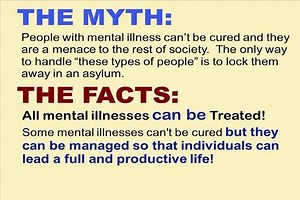
I personally see your work as a book of pain, despite the uplifting and encouragement it can provide to the reader. However, I know your memoirs are effective in portraying what it's like to suffer from mental illness. Was it your intention to display your pain in so raw a manner? 
Myths and Facts About Mental Illness
Image taken from http://www.siue.edu/~pfricke/
Yes, that was my intention. I feel like being 100% raw and realistic is the only way to go with my story. I felt it was important for people to understand just how crippling mental illness can be. I wanted others who experience it to know that you can overcome even the darkest days of your illness. Not to mention the healing aspect for me. Putting it out there really helps me start on the path to acceptance and recovery. 

I personally know the draw of isolating oneself from others, but I fight the inclination despite negative thoughts. How do you fight it, or is it sometimes better for you to give in to it for a while, in order to get back on top of things? 
I feel like it’s essential to know when it’s time to take a bit of a break. I’ve personally left social media for a couple of weeks at a time just to bring a sense of calm to my life. I would tell anyone that time (to) your self is very important. However, you can’t pack up and live there. That’s when the destructive thoughts start to creep in, at least for me. In my opinion being alone is different from feeling alone. You have to do what is best for you. 

Well, there it is. It was wonderful having you and I would love to keep in touch in the future!

Follow author @BekaLombardo on Twitter. 


I recommend to: Everyone seeking to have an understanding of mental illness,  those who need someone to relate to in their own struggles with mental health issues, and anyone looking to simply know how others sometimes think. 


I must reiterate that I suggest use of caution for those who suffer from a mental illness of their own when considering reading this book. Please do make sure you are "in a good place" before reading. 

Thursday, May 8, 2014

One for Young-at-Heart Romantics

Linnet and the Prince 
by Alydia Rackham

My rating on a 100-point scale: 94

My recommender: 
     The author herself e-mailed me and asked if I'd read and review her book. I was provided with a free copy in exchange for an honest review.

My synopsis: 
     Linnet is the younger of two princesses of Hilrigard. When Hilrigard is overtaken by the formidable Badi people, the Badi prince Rajak gives the Queen a choice: give him a princess for his wife or force him to slaughter the whole Hilrigard kingdom. Linnet, the tougher of the two princesses, chooses to go in her sister's place, and is tasked by her mother to kill the prince on the eve of the Water Gathering festival, two months hence. But the prince is not what he seems, and Linnet slowly but surely falls for the gentle and kind prince. And things get very complicated when her mother's "brother" assassins come to rescue Linnet the eve of the Water Gathering festival.

My review:
     I very much enjoyed this book. The characters are loveable; the story is captivating; the cultural elements are intriguing; the politics are realistic; and I couldn't help but wish for more story to come at the end. I very much appreciate the author's straight-forward, no-beating-around-the-bush, quick and simple way of telling the story, as this makes for a quick, yet intriguing and enjoyable read. 
     However, I must mention the negative: Characters "hiss" when they speak, and I'm not sure how this is possible or true. There were very little typos, but I did catch a few, including one which I think was supposed to be "every" but was actually "emach," or something along those lines. The formatting was slightly skewed in a few places. Also, the ending, the more I think about it, is a mite puzzling, but I won't provide any spoilers here.

I recommend to: 
Anyone and everyone who enjoys a good story, especially those involving clean and believable romance. 

I do not suggest this book for children under the age of 10, due to elements of mild gore.

Saturday, April 19, 2014

Warrior's Woman (Ly-San-Ter, #1)Warrior's Woman 
by Johanna Lindsey

My rating on a 100-point scale: 90 

My Review:
     This isn't the best romance I have ever read, but it is pretty decent, in my opinion.
     There is much to love about this book: the science fiction elements, the future mixing with the past, the political reasons driving the story, and the unique mixing of cultures and beliefs, among many other things. The sensual scenes are relatively satisfying to read, as well, though a little cliche at times.
     However, there are a few things that one could very well dislike. Such as: A strong modern heroine being conquered by an animalistic feudal leader, who just happens to be exactly what she needed. The over-bearing male dominance in this novel is nearly sickening, however well it plays into the romance side of things. I have to admit that I was a bit like, "Really, that far?" when the male main character was first introduced. I feel like a few elements were just a bit overdone, that's all.
     Overall, this book is a good read. I highly recommend if you're a romance genre fan who may like a little science-fiction, futuristic element.

I recommend to: 
Fans of the romance genre.
  
I would not recommend this novel for anyone under the age of 15 due to multiple scenes of a sexual nature.


Tuesday, October 1, 2013

National Poetry Day

Water

Image from etftrends.com
   Despite the fact that I'm American, I'm all about celebrating the written word. So, though October 3rd is National Poetry Day for the United Kingdom, I choose to help celebrate it. After all, some of my ancestors were from that relative area of the world - I have a bit of Scottish blood in me. I also have a decent amount of Native American blood in me, but that is beside the point. I'm part English. So I can participate in the UK's National Poetry Day, right? 
   Any way, I'm posting one of my own poems today. It'll be included in my short works collection I am due to release before the year's out. 
   This year's theme for National Poetry Day is Water and I have the perfect poem to share. I wrote it in July of last year and hereby share it with my readers.


Eternal Life

a coffin for a shower, who would’ve ever thought
that eternal life could be found in simple water
it runs to catch itself with gravity’s help, like a bus picking up passengers
it has to go a little out of its way for love
it just wants to be closer to atoms just like itself
so simple yet so complex, this love of self
Image from smscs.com
they’ll say, oh how she loved her baths
but oh they’ll never know what I found in this coffin
their highfalutin ways blind them, they’ll never see
highfalutin, someone angry made up that word: highfalutin
the water is so warm surrounding my frame
I listen to its blurred message
so silent one can only hear when submersed
blood is the answer for Christians, blood and water
blood and water for eternal life in Christ
water is the answer to Heaven, the accumulation is Paradise – so simple and so common a thing
and He put it right in front of our face
water runs through my veins, mixes with my blood
it races to catch itself
to join close with its friends and wait for the end
surface tension
broken by more coming to join in to wait for the end
a crowd of an uncountable number of lives in this coffin
just waiting
just swirling down the drain, waiting for the end

Faye Hollidaye, July 2012


   I hope you enjoyed! Leave me a comment below and let me know what you think, or leave me one of your poems - I'd love to read them. I'd also like to know what your favorite poem of all time is, so feel free to share!